Disclaimer:
The information on this website is for general guidance only and does not constitute financial or investment advice. Always do your own research and seek personalised advice from a qualified financial adviser or mortgage adviser before making financial decisions. All investments carry risk and past performance is not indicative of future results.
Key Takeaways
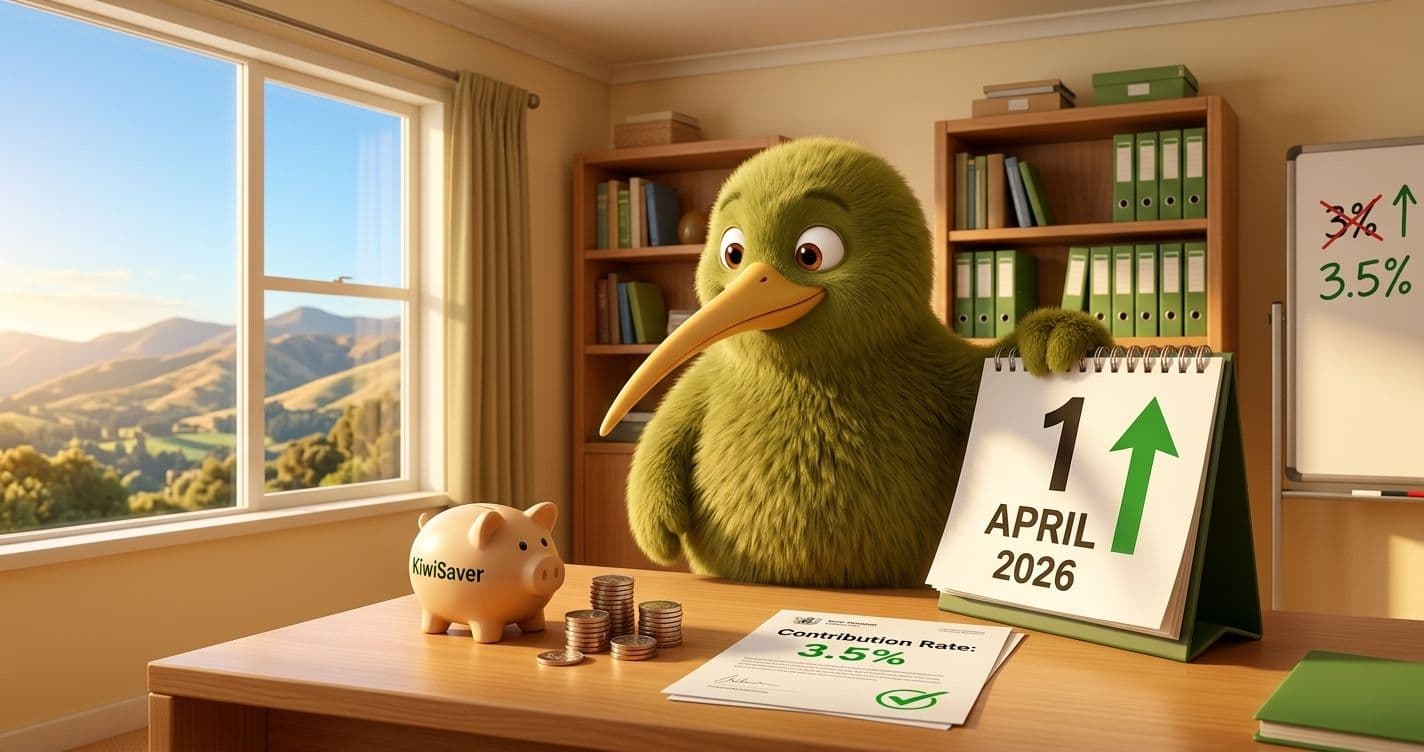
- If you are on the 3% minimum/default rate, employee and eligible employer contributions generally rise to 3.5% on 1 April 2026.
- 16 and 17-year-olds can qualify for employer contributions from 1 April 2026 if they meet KiwiSaver eligibility requirements.
- Government contribution reduced to 25c per $1, max $260.72/year. You must meet eligibility rules, including the taxable-income limit, and contribute at least $1,042.86 of your own money to get the full amount.
- Rural, farm, and service-tenancy workers are covered by proposed first-home withdrawal changes that still need to be enacted and commenced.
- Core first home withdrawal rules remain unchanged — 3 years, keep $1,000.
If you've got a KiwiSaver account — and you're dreaming of owning your first home — now is a really good time to pay attention. The government has rolled out a raft of KiwiSaver changes that are quietly reshaping what's possible for first home buyers. More money going in, more people who can access it, and some genuinely helpful rule changes for those in tricky situations.
Change #1: Contributions Are Going Up
This is the big one that affects everyone. The default KiwiSaver contribution rate — what you and your employer both put in — is rising for the first time in years.
Effective 1 April 2026 — Default rate rises from 3% to 3.5%
If you are on the 3% minimum/default rate, your employee contribution and eligible employer contribution generally move to 3.5% from 1 April 2026. If you already contribute above 3%, your own contribution may not change. Then, in April 2028, the minimum/default rate rises again to 4%.
In real terms, on a $70,000 salary that's roughly an extra $700 per year flowing into your KiwiSaver account — $350 from you and $350 from your employer. The more you earn, the bigger that boost. Over several years, that compounds significantly.
Not in a position to absorb the higher deduction right now? You can apply for a temporary rate reduction to stay at 3% for between 3 and 12 months. Just know it's a short-term pause, not a permanent opt-out.
Club Tip
If your budget allows, the higher contribution rate may increase the amount going into KiwiSaver. Check your cashflow, timeframe, and advice needs before changing contributions.
Not sure if your contribution rate is working hard enough for you? Get your free KiwiSaver check-up →
Change #2: Younger Kiwis Can Build Sooner
If you are 16 or 17 and working, this is a meaningful shift. 16 and 17-year-olds can qualify for government contributions from 1 July 2025 and employer contributions from 1 April 2026, as long as they meet the other KiwiSaver eligibility requirements.
That means a teenager in their first part-time job can now get the full trio of contributions: their own, their employer's, and the government's. Starting earlier means a bigger pot by the time homeownership becomes a real goal.
Need personalised guidance?
Chat with a First Home Buyers Club affiliated mortgage adviser - no obligation!
Have a question about this?
Post it in the First Home Buyers Club forum — get answers from the community and industry professionals.
Change #3: The Government Contribution Has Changed
The government still adds to your KiwiSaver each year, but the amount has reduced. From 1 July 2025, eligible KiwiSaver members receive 25 cents for every $1 they contribute, up to a maximum annual government contribution of $260.72. To get the full amount, you need to contribute at least $1,042.86 of your own money between 1 July and 30 June each year. People earning over $180,000 taxable income a year do not qualify, and employer contributions, past government contributions, and Australian retirement transfers do not count toward the $1,042.86. People earning over $180,000 taxable income a year do not qualify, and employer contributions, past government contributions, and Australian retirement transfers do not count toward the $1,042.86. People earning over $180,000 taxable income a year do not qualify, and employer contributions, past government contributions, and Australian retirement transfers do not count toward the $1,042.86. People earning over $180,000 taxable income a year do not qualify, and employer contributions, past government contributions, and Australian retirement transfers do not count toward the $1,042.86. People earning over $180,000 taxable income a year do not qualify, and employer contributions, past government contributions, and Australian retirement transfers do not count toward the $1,042.86. People earning over $180,000 taxable income a year do not qualify, and employer contributions, past government contributions, and Australian retirement transfers do not count toward the $1,042.86. People earning over $180,000 taxable income a year do not qualify, and employer contributions, past government contributions, and Australian retirement transfers do not count toward the $1,042.86. People earning over $180,000 taxable income a year do not qualify, and employer contributions, past government contributions, and Australian retirement transfers do not count toward the $1,042.86. People earning over $180,000 taxable income a year do not qualify, and employer contributions, past government contributions, and Australian retirement transfers do not count toward the $1,042.86. People earning over $180,000 taxable income a year do not qualify, and employer contributions, past government contributions, and Australian retirement transfers do not count toward the $1,042.86. People earning over $180,000 taxable income a year do not qualify, and employer contributions, past government contributions, and Australian retirement transfers do not count toward the $1,042.86. People earning over $180,000 taxable income a year do not qualify, and employer contributions, past government contributions, and Australian retirement transfers do not count toward the $1,042.86. People earning over $180,000 taxable income a year do not qualify, and employer contributions, past government contributions, and Australian retirement transfers do not count toward the $1,042.86. People earning over $180,000 taxable income a year do not qualify, and employer contributions, past government contributions, and Australian retirement transfers do not count toward the $1,042.86. People earning over $180,000 taxable income a year do not qualify, and employer contributions, past government contributions, and Australian retirement transfers do not count toward the $1,042.86. People earning over $180,000 taxable income a year do not qualify, and employer contributions, past government contributions, and Australian retirement transfers do not count toward the $1,042.86. People earning over $180,000 taxable income a year do not qualify, and employer contributions, past government contributions, and Australian retirement transfers do not count toward the $1,042.86. People earning over $180,000 taxable income a year do not qualify, and employer contributions, past government contributions, and Australian retirement transfers do not count toward the $1,042.86. People earning over $180,000 taxable income a year do not qualify, and employer contributions, past government contributions, and Australian retirement transfers do not count toward the $1,042.86. People earning over $180,000 taxable income a year do not qualify, and employer contributions, past government contributions, and Australian retirement transfers do not count toward the $1,042.86. People earning over $180,000 taxable income a year do not qualify, and employer contributions, past government contributions, and Australian retirement transfers do not count toward the $1,042.86. People earning over $180,000 taxable income a year do not qualify, and employer contributions, past government contributions, and Australian retirement transfers do not count toward the $1,042.86.
It is a smaller boost than before, but it may still be useful if you are eligible. Check the contribution threshold, income limit, and what counts as your own contribution before relying on the full amount.
Want to check how the government contribution rules apply to you? Get your free KiwiSaver check-up →
Change #4: Proposed Rural and Service-Tenancy Access Changes
This proposed change matters for some workers whose jobs require them to live in employer-provided housing. Current first-home withdrawal rules still need to be checked carefully until the law is enacted and commenced.
Bill expected mid-2026 — Service tenancy workers to get access
Rural, farm, and service-tenancy workers are the subject of proposed KiwiSaver first-home withdrawal changes. A government bill was expected in mid-2026, with the rules to apply only after the law is enacted and commenced. Once in force, the changes may help workers whose jobs require employer-provided housing and some first-time farm buyers, but the detail should be checked against the final law.
What Stays the Same
Amid all the changes, the core KiwiSaver first home withdrawal rules remain unchanged. You still need to have been a KiwiSaver member for at least three years. You can still withdraw almost everything in your account — all but $1,000 must remain. And the property you are buying still needs to be in New Zealand and be your principal place of residence, unless a specific enacted exception applies.
The First Home Loan through Kāinga Ora is also still available for eligible buyers through selected lenders, with as little as a 5% deposit. A KiwiSaver first-home withdrawal may form part of that deposit if the buyer meets the withdrawal rules.
What Should You Do Right Now?
- Check your contribution rate. If you are on the 3% minimum/default rate, you generally move to 3.5% from 1 April 2026. If your budget allows, the higher rate may increase the amount going into KiwiSaver.
- Check whether you are eligible for the full government contribution. You need to contribute at least $1,042.86 of your own money between July and June to get the maximum $260.72 government contribution, and the income and contribution-source rules matter.
- Calculate what you'll have at the time of purchase. If you're within a few years of buying, work out your projected balance and factor in the higher contributions.
- If you're a rural or service tenancy worker, the amendment bill expected mid-2026 may open up access you didn't have before. It still needs to pass into law — watch for the official announcement and talk to an adviser.
KiwiSaver can be an important part of a first-home deposit plan, but contribution choices, timing, and withdrawal rules are personal. Check the current rules and get advice if you are unsure.
Ready to see how your KiwiSaver stacks up? Get your free KiwiSaver check-up →
Have a first-home-buyer question?
Browse related forum discussions
Public forum questions are searchable, with answer previews for visitors and full discussions for free members.
Frequently Asked Questions
Need personalised guidance?
Chat with a First Home Buyers Club affiliated mortgage adviser - no obligation!
Have a question about this?
Post it in the First Home Buyers Club forum — get answers from the community and industry professionals.
Related Articles

Using KiwiSaver to Buy Your First Home: Complete Guide
Complete guide to using your KiwiSaver savings to buy your first home in New Zealand. Covers current withdrawal rules, eligibility, and how KiwiSaver fits with low-deposit pathways.

Why Your KiwiSaver Fund Choice is so Important for First-Home Buyers
Essential guide for first-home buyers on choosing the right KiwiSaver fund. Learn about growth vs conservative funds and matching your fund to your timeline.

How Market Volatility Can Hurt First Home Buyers Using KiwiSaver
Essential guide for first-home buyers on protecting your KiwiSaver deposit from market volatility. Learn when to switch to a Conservative Fund.

5 Tips to Boost Your KiwiSaver First Home Deposit
Practical tips for boosting your KiwiSaver for a first home deposit. Learn about contributions, fund choices, and maximising government credits.