Disclaimer:
The information on this website is for general guidance only and does not constitute financial or investment advice. Always do your own research and seek personalised advice from a qualified financial adviser or mortgage adviser before making financial decisions. All investments carry risk and past performance is not indicative of future results.
Key Takeaways
- Relationship property law can affect a home even where contributions or legal ownership are unequal.
- A Contracting Out Agreement can record agreed treatment of property, but it must meet formal legal requirements.
- Consider independent legal advice on a COA early, especially before settlement or major contributions.
- Property Sharing Agreements can record ownership shares, costs, decisions and exit arrangements for friends or siblings buying together.
- Sole-name ownership does not automatically remove relationship-property risk.
The team at Schnauer & Co's have put together a resource toolkit to highlight common legal issues for first home buyers. In this Part 6 of the series, we talk about COAs and Property Sharing Agreements, and why independent legal advice and clear written agreements can matter when a home involves a partner, family member, friend or unequal contribution.
Understanding Relationship Property Law
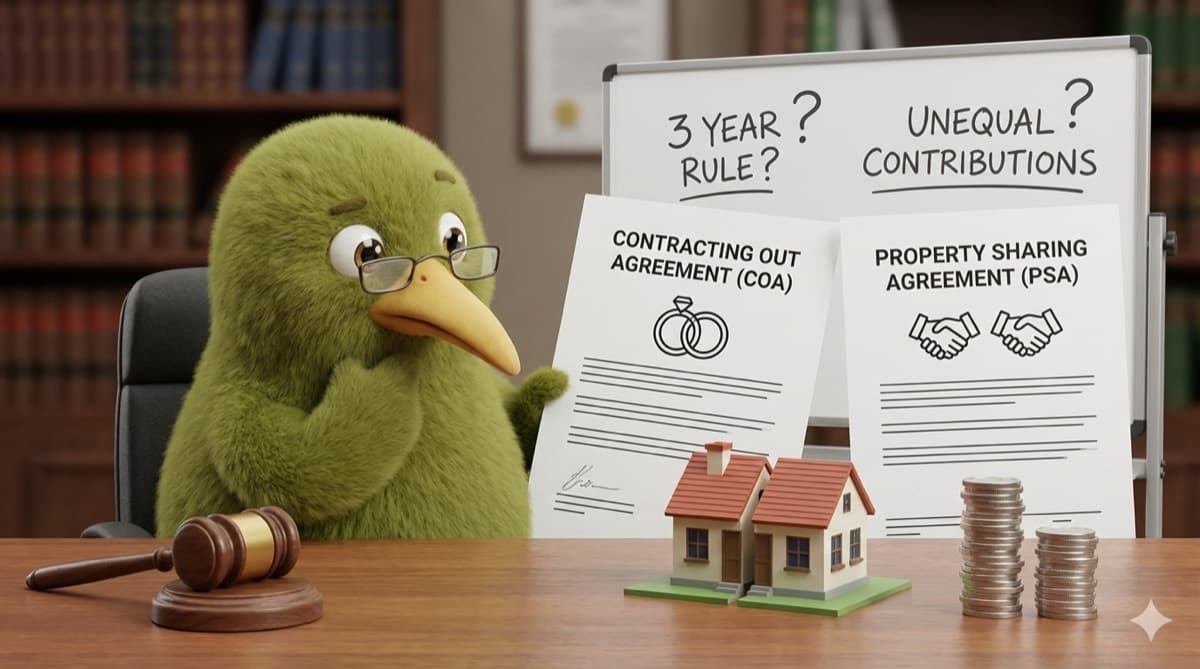
Once a relationship reaches the relevant Property (Relationships) Act 1976 threshold, relationship property is generally divided equally unless the Act, a court order, or a valid contracting-out agreement leads to a different result. The rules can also apply in some shorter relationships, so legal advice matters before relying on a simple 3-year rule.
The Act Applies To:
- Married or civil union couples, with special rules for relationships of short duration
- De facto couples, including same-sex couples, usually once the relationship has lasted at least 3 years; shorter de facto relationships can be covered in special circumstances.
What is a Contracting Out Agreement (COA)?
For couples purchasing property with unequal contributions, a contracting-out agreement ("COA") may be the relevant legal tool. It can be made before or during a relationship and can record how specified property will be treated if the relationship ends, but it must satisfy the Act's formal requirements, including independent legal advice for each party.
Need personalised guidance?
Chat with a First Home Buyers Club affiliated mortgage adviser - no obligation!
Have a question about this?
Post it in the First Home Buyers Club forum — get answers from the community and industry professionals.
Legal-advice prompt: If unequal contributions, family gifts or inherited funds are involved, ask separate lawyers early whether a COA is appropriate and what formalities are required before signing.
A separation or relationship property agreement ("RPA") is what is entered into when a couple decide to separate and they want to document the agreement made between them to divide their relationship assets.
When Are COAs Commonly Used?
COAs may be considered where people want to record how existing property, family gifts, inheritances, assets for children from previous relationships, or future property should be treated. Whether a COA is suitable depends on the relationship, the property involved and the legal advice each person receives.
Important: Where parents or family members contribute to a first-home purchase, ask a lawyer before settlement how that contribution should be documented and whether a COA, loan agreement, gift record or other arrangement is appropriate.
Common Misconceptions
It can be useful to get advice on how the Act may affect you before a relationship reaches the 3-year mark, especially if you are buying property, receiving family help, or making unequal contributions.
A Common Mistake: Some buyers assume that sole-name ownership or being the only person servicing the mortgage will automatically keep a home outside relationship-property rules. It is not that simple. Outcomes depend on the Act, the facts, and any valid agreement.
Some buyers rely on the generic "it has not been 3 years yet" rule. That can be risky because the Act can apply to shorter relationships in special circumstances, and relationship-property planning is usually easier before a dispute or settlement deadline.
These conversations can be difficult, but they are better handled with clear legal advice before expectations harden or money changes hands.
What is a Property Sharing Agreement (PSA)?
For siblings, friends or other groups buying together, ask a lawyer about a property sharing agreement ("PSA") or co-ownership agreement before committing to the purchase.
In simple terms, a PSA is a written agreement that outlines how two or more people will share ownership, use, costs and decisions for a property. It is commonly used when friends or family buy together and need clarity about shares, responsibilities and exits.
A PSA Specifies:
- The percentage of ownership each person has
- How expenses like mortgage payments and maintenance costs will be divided
- How decisions regarding the property will be made
- What happens if one co-owner wants to sell their share
- How disputes between the owners will be resolved
The goal of a PSA is to record everyone's rights and responsibilities for the property. It can reduce uncertainty, but it still needs careful drafting and legal advice because co-owners can remain jointly liable for mortgage obligations.
Costs
Property Sharing Agreement: legal costs vary depending on what is involved, how complex the arrangement is, how many parties are involved and whether separate advice is needed.
Before signing, ask for a quote and confirm how legal fees will be paid. Do not assume a lender contribution will cover the cost or that one lawyer can advise every party on the same terms.
Have a first-home-buyer question?
Browse related forum discussions
Public forum questions are searchable, with answer previews for visitors and full discussions for free members.
Frequently Asked Questions
Need personalised guidance?
Chat with a First Home Buyers Club affiliated mortgage adviser - no obligation!
Have a question about this?
Post it in the First Home Buyers Club forum — get answers from the community and industry professionals.
Related Articles

A First Home Buyer's Guide to Real Estate Terms and Sale Methods in New Zealand
Essential guide to understanding real estate terms, sale methods, and property jargon for first-home buyers in New Zealand. Learn about auctions, deadline sales, and more.

Buying a Monolithic or Plaster Home in New Zealand: What First Home Buyers Should Know
Essential guide for first-home buyers considering monolithic or plaster homes in New Zealand. Learn about weathertightness, inspections, insurance, and legal protections.

How to Secure a New Build with a 5% Deposit
Learn how first-home buyers can secure a new build in Auckland with just 5% deposit using the First Home Loan scheme and KiwiSaver.

How to Supercharge Your First Home Deposit in New Zealand
Learn proven strategies to accelerate your savings and reach your deposit goal faster with KiwiSaver and smart saving techniques.