Disclaimer:
The information on this website is for general guidance only and does not constitute financial or investment advice. Always do your own research and seek personalised advice from a qualified financial adviser or mortgage adviser before making financial decisions. All investments carry risk and past performance is not indicative of future results.
Key Takeaways
- Encroachments can create boundary, title and neighbour-dispute risks.
- Review the record of title, deposited plan and physical boundaries early.
- Raise boundary or title concerns with your lawyer before relying on an agreement or going unconditional.
- Current owners may inherit boundary problems, but responsibility and remedies depend on the facts and legal process.
- Possible solutions include neighbour agreement, boundary adjustment, easement, removal, compensation or court orders.
Every so often, Schnauer & Co will have enquiries from clients about an encroachment that they have become aware of, many years after purchasing their property. For example, you have your land surveyed and find out that your neighbour has built a fence, not on the boundary, but actually on your land. Or there is a structural addition that extends beyond the legal property boundaries.
Usually this is picked up when owners are selling (during the purchaser's due diligence) or if they are considering subdivision/construction of any extensions or additions.
Important Warning:
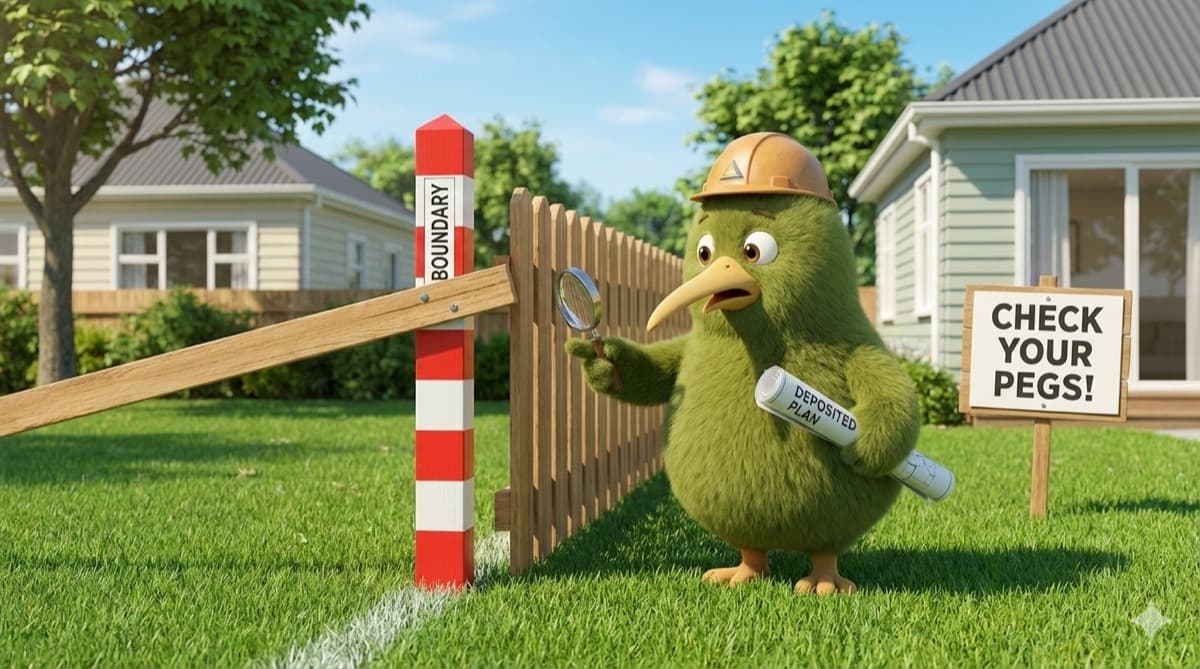
It is not uncommon for purchasers to struggle to locate boundary pegs and to decide not to have the property surveyed. This creates a risk that there could be a boundary encroachment or the land you assume will be yours, isn't. This can create title, lending, saleability and neighbour-dispute issues, especially if the legal boundary does not match what appears on the ground.
Understanding Your Property Boundaries
When you purchase a property, your lawyer or conveyancer should help you review the record of title and deposited plan. Settled.govt.nz notes that a title records ownership, boundary and access information held by LINZ, but practical boundary questions may still need survey input.
Tip: Check the physical boundaries early and ask your lawyer whether a survey is needed before signing or before conditions are confirmed. Online mapping tools can be useful for orientation, but they may not prove the legal boundary.
Need personalised guidance?
Chat with a First Home Buyers Club affiliated mortgage adviser - no obligation!
Have a question about this?
Post it in the First Home Buyers Club forum — get answers from the community and industry professionals.
What to Do If You Discover an Encroachment
If you become aware of a possible title or boundary issue such as an encroachment, contact your lawyer promptly. Sale and purchase agreements can include title-requisition or due-diligence rights, but timeframes and remedies depend on the agreement wording and the facts.
Try to resolve title, boundary or notice issues before confirming conditions or going unconditional. Once an agreement is unconditional, your options may be more limited and depend on the contract and legal advice.
"Limited as to Parcels" Titles
Some older titles have a notation "limited as to parcels", meaning the title boundaries or land area are not guaranteed until the limitation is removed through the proper survey process. Be especially careful where buildings, fences or extensions are close to an estimated boundary.
Who is Responsible?
A current owner may inherit the practical problem of an encroachment, but responsibility and remedies are fact-specific. The Property Law Act 2007 gives the court powers to grant relief for a wrongly placed structure where it is just and equitable.
Legal boundaries are recorded through the survey and title system. If there is a dispute that cannot be resolved between neighbours, a licensed surveyor can help establish the boundary position and replace missing boundary marks, while your lawyer can advise on the legal process.
Options for Resolving Encroachments
Negotiation Option:
You may be able to negotiate with your neighbour about removal, an easement, compensation or a boundary adjustment. A boundary adjustment can require survey, legal documentation and any required subdivision or council approvals.
Court Application
Alternatively, a court application may be available. Under the Property Law Act 2007, the court may grant relief for a wrongly placed structure if it considers relief just and equitable in the circumstances. Orders may include:
- Reasonable compensation, if ordered by the court
- Allowing or directing removal of the structure
- Giving a party rights of possession over land or the structure
- Vesting specified land in a party with an interest in the affected land or intended land
- Granting an easement over specified land
Fence Encroachments
If a fence is not on the boundary line, the Fencing Act 1978 may apply. The Act says the middle of a fence should be on the boundary line unless otherwise agreed or ordered by the court, and no person is entitled to erect a fence that encroaches on another occupier's land without consent or a court order. The court has jurisdiction over disputes about the removal of a fence not erected on the proper boundary.
Fence Removal May Depend On:
- Whether the fence encroaches and how significant the encroachment is; and
- Whether the encroachment affects use and enjoyment of the land, alongside the court process and available evidence.
Related reading: Neighbourly tensions and fencing disputes can involve both practical neighbour negotiation and legal process, so get advice before removing or altering a boundary fence.
Have a first-home-buyer question?
Browse related forum discussions
Public forum questions are searchable, with answer previews for visitors and full discussions for free members.
Frequently Asked Questions
Need personalised guidance?
Chat with a First Home Buyers Club affiliated mortgage adviser - no obligation!
Have a question about this?
Post it in the First Home Buyers Club forum — get answers from the community and industry professionals.
Related Articles

A First Home Buyer's Guide to Real Estate Terms and Sale Methods in New Zealand
Essential guide to understanding real estate terms, sale methods, and property jargon for first-home buyers in New Zealand. Learn about auctions, deadline sales, and more.

Buying a Monolithic or Plaster Home in New Zealand: What First Home Buyers Should Know
Essential guide for first-home buyers considering monolithic or plaster homes in New Zealand. Learn about weathertightness, inspections, insurance, and legal protections.

How to Secure a New Build with a 5% Deposit
Learn how first-home buyers can secure a new build in Auckland with just 5% deposit using the First Home Loan scheme and KiwiSaver.

How to Supercharge Your First Home Deposit in New Zealand
Learn proven strategies to accelerate your savings and reach your deposit goal faster with KiwiSaver and smart saving techniques.