Disclaimer:
The information on this website is for general guidance only and does not constitute financial or investment advice. Always do your own research and seek personalised advice from a qualified financial adviser or mortgage adviser before making financial decisions. All investments carry risk and past performance is not indicative of future results.
Key Takeaways
- Fencing rules can be affected by covenants and heritage status.
- The Fencing Act sets out shared cost rules and notice steps.
- Notices need clear scope, costs, and consequences.
- Neighbour objections must be lodged within set timeframes.
- Disputes can be resolved through the Disputes Tribunal.
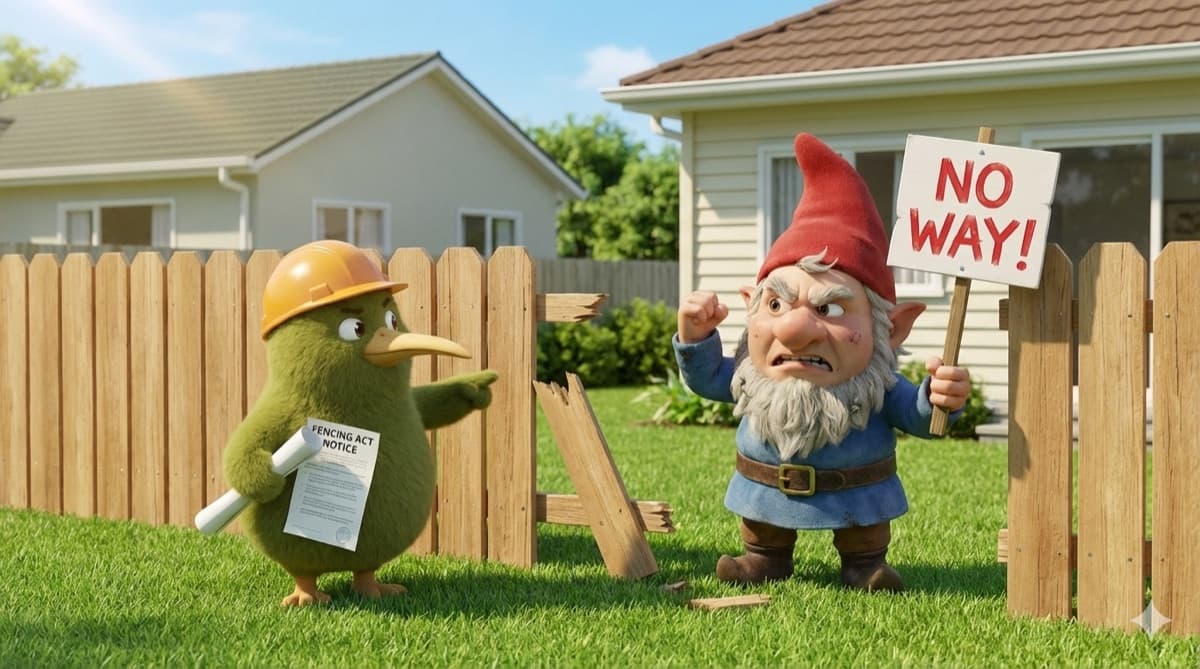
Picture this: a classic showdown between neighbours, with the humble fence caught in the middle. This has the potential to turn nasty so read on to get an understanding of the laws around fences.
Under MBIE Building Performance guidance, a building consent is usually not required for fences or hoardings up to 2.5 metres high, but pool fences are treated separately and district plans may still require resource consent for fences over certain heights, often over 2 metres. Covenants, heritage rules and local planning controls can also affect height, materials and colour.
Fencing Covenants and Agreements
A fencing covenant is an agreement between two parties where one party may not be required to contribute towards the costs of erecting a fence or the costs of any work to be carried out on a fence. If a fencing covenant is registered after 1 April 1979, it will expire automatically 12 years from the date it was registered. Subject to this, the burden of a registered fencing covenant will run with the land. The benefit of a fencing covenant will not bind any subsequent purchasers of the adjoining land (only bind the original parties). It is common for developers to register these, to avoid being liable for fencing costs when they sell lots once titles have issued and they may remain an owner of some adjoining lots in the subdivision.
A fencing agreement is similar to a covenant except it allows the benefit of the agreement to run with the land and be passed on to any subsequent owners.
What If There's No Valid Fencing Covenant or Agreement?
Need personalised guidance?
Chat with a First Home Buyers Club affiliated mortgage adviser - no obligation!
Have a question about this?
Post it in the First Home Buyers Club forum — get answers from the community and industry professionals.
Section 9 of the Fencing Act 1978 sets the general rule that adjoining occupiers share the cost of work on an adequate boundary fence in equal proportions, subject to the Act and any court order. The Act also covers situations such as damage caused by one occupier, fencing notices, cross-notices and the timeframes for responding.
General Rule: 50/50 shared costs between neighbours. However, some neighbours may agree to a different split (e.g. 70/30) because one neighbour may want a certain expensive style of fence whereas the other neighbour was keen on a more affordable option.
NZ Government guidance says the first step is to talk to the neighbour who shares the boundary and try to agree on the fence height, materials and cost before using the Fencing Act notice process or taking a dispute further.
What is an "Adequate Fence"?
An "adequate fence" is not necessarily the type of fence you may have in mind. Depending on the area or land, a high-security, modern fence that you may be after may not be considered reasonable. For example, in a rural setting just a hedge or farming fencing may be considered as adequate.
The Fencing Notice Process
The Act sets out a specific notice process for an occupier who wants a neighbour to contribute to fencing work. Because notices affect legal rights and cost liability, use the statutory form or a notice to like effect and check official guidance or legal help if the boundary, title or wording is unclear.
The Fencing Notice Must Contain:
- A description of the boundary along which the work will be done
- Information about the proposed works to be undertaken
- An estimate of the costs for the work
- Details of the consequences of failure to comply with the notice
If your neighbour does not agree with what is proposed in the notice, an objection can be made within 21 days by serving a cross-notice. Your neighbour may propose a different approach in their cross-notice. By way of an example, they may think that the existing fence is adequate or that the proposed new fence is too expensive. Notices should not be ignored.
If you and your neighbour cannot agree, the dispute may be taken to the Disputes Tribunal or District Court depending on the issue. Under current section 24A of the Fencing Act, the Disputes Tribunal cannot make fencing orders or judgments above $60,000.
When Your Neighbour Won't Have to Contribute
Your neighbour will not be required to contribute to the costs of erecting or carrying out work on a fence where:
- The work is done prior to the relevant notice being served
- The work is done between service of the notice and before service of a cross-notice
- The work is done while any dispute about the work is being resolved
The above gives you a snapshot of the ins and outs of the law around fences. Just remember, communication is key to keeping the peace in the neighbourhood.
Have a first-home-buyer question?
Browse related forum discussions
Public forum questions are searchable, with answer previews for visitors and full discussions for free members.
Frequently Asked Questions
Need personalised guidance?
Chat with a First Home Buyers Club affiliated mortgage adviser - no obligation!
Have a question about this?
Post it in the First Home Buyers Club forum — get answers from the community and industry professionals.
Related Articles

A First Home Buyer's Guide to Real Estate Terms and Sale Methods in New Zealand
Essential guide to understanding real estate terms, sale methods, and property jargon for first-home buyers in New Zealand. Learn about auctions, deadline sales, and more.

Buying a Monolithic or Plaster Home in New Zealand: What First Home Buyers Should Know
Essential guide for first-home buyers considering monolithic or plaster homes in New Zealand. Learn about weathertightness, inspections, insurance, and legal protections.

How to Secure a New Build with a 5% Deposit
Learn how first-home buyers can secure a new build in Auckland with just 5% deposit using the First Home Loan scheme and KiwiSaver.

How to Supercharge Your First Home Deposit in New Zealand
Learn proven strategies to accelerate your savings and reach your deposit goal faster with KiwiSaver and smart saving techniques.