
Disclaimer:
The information on this website is for general guidance only and does not constitute financial or investment advice. Always seek personalised advice from a qualified mortgage adviser before making financial decisions.
Key Takeaways
- The OCR influences interest rates, but it is not the only thing that matters.
- Inflation is a major reason rates rise or fall over time.
- Fixed mortgage rates are often driven more by wholesale markets than the OCR alone.
- Your actual rate can also be affected by your deposit size and loan structure.
- The goal is not to perfectly predict rates, but to compare structures, buffers and advice questions before choosing.
Interest rates are one of the biggest factors affecting what first home buyers can afford in New Zealand, but they are often confusing and misunderstood. This guide explains key influences on interest rates, including the OCR, inflation, wholesale rates, and loan structure, in a simple, practical way so you can ask better questions and compare options.
What Influences Interest Rates in New Zealand?
Interest rates are one of the most talked-about parts of buying your first home. You will hear about them in the news, see them change at banks, and feel their impact directly through your repayments.
But for something so important, they are often not well understood.
Rates do not just move randomly. They are influenced by a combination of economic forces, bank decisions, and market expectations, all working together behind the scenes.
If you understand the main forces behind interest rates, you are in a better position to ask lender or adviser questions and compare home-loan options.
The Starting Point: The Official Cash Rate (OCR)
The Official Cash Rate (OCR) is a key influence on New Zealand interest rates. The Reserve Bank says the OCR is its main tool for keeping inflation between 1% and 3%, and the Monetary Policy Committee reviews it eight times a year.
You can think of the OCR as an important anchor, but not the only factor, in the interest-rate system.
When the Reserve Bank changes the OCR, interest rates on mortgages, loans and savings accounts often change too. The timing and size of mortgage-rate changes still depend on lender pricing, funding costs and market expectations.
However, mortgage rates do not always move in perfect sync with the OCR. Banks often adjust their rates based on where they think the OCR is heading, not just where it is today.
This is why you will sometimes see mortgage rates move even when the OCR has not changed.
Inflation: The Real Reason Rates Move
Inflation is one of the main reasons the OCR changes.
Inflation refers to the increase in prices over time. When inflation is high, everyday costs like food, rent, and fuel rise quickly.
The Reserve Bank uses monetary policy to keep inflation low and stable, with a target range of 1% to 3% over the medium term and a focus on the 2% midpoint. Depending on the outlook, it may adjust the OCR to influence demand and inflation pressure.
This can flow through to interest rates, although mortgage rates do not always move one-for-one with the OCR.
When inflation pressures rise, interest rates may rise; when inflation pressures ease, rates may stabilise or fall. The path is not automatic, because the Reserve Bank and lenders also consider forecasts, risks and funding conditions.
For first home buyers, inflation is an important background influence on mortgage rates. Even if you are not tracking it closely, it can affect the cost of future repayments through monetary-policy and market expectations.
Need personalised guidance?
Chat with a First Home Buyers Club affiliated mortgage adviser - no obligation!
Have a question about this?
Post it in the First Home Buyers Club forum — get answers from the community and industry professionals.
Wholesale Interest Rates: What Banks Pay for Money
One of the most important influences on mortgage rates is something most people never hear about: wholesale interest rates.
Banks do not just lend out money from savings accounts. A large portion of their funding comes from broader financial markets, and wholesale rates represent the cost of that funding.
These rates are influenced by global conditions, including overseas interest rates, investor expectations, and economic outlooks.
This is particularly important for fixed mortgage rates.
While the OCR has a strong influence on floating rates, fixed rates are more closely tied to wholesale rates. That means fixed rates can move independently of the OCR.
This is why you might see fixed rates rise or fall even when there has not been any official announcement from the Reserve Bank.
Bank Costs, Funding and Competition
Banks are businesses, and like any business, their pricing is influenced by costs and competition.
Their costs include wholesale funding, the interest they pay to savers, and their operating expenses. If these costs increase, lending rates often follow.
Competition also plays a role. When banks are competing strongly for customers, they may offer lower rates or additional incentives. When competition is less intense, rates may stay higher.
This means the rate you are offered is not just about the economy. It is also about the lending environment at the time.
Low Equity Margins: Why Your Deposit Matters
For many first home buyers, one of the biggest influences on their actual interest rate is their deposit size.
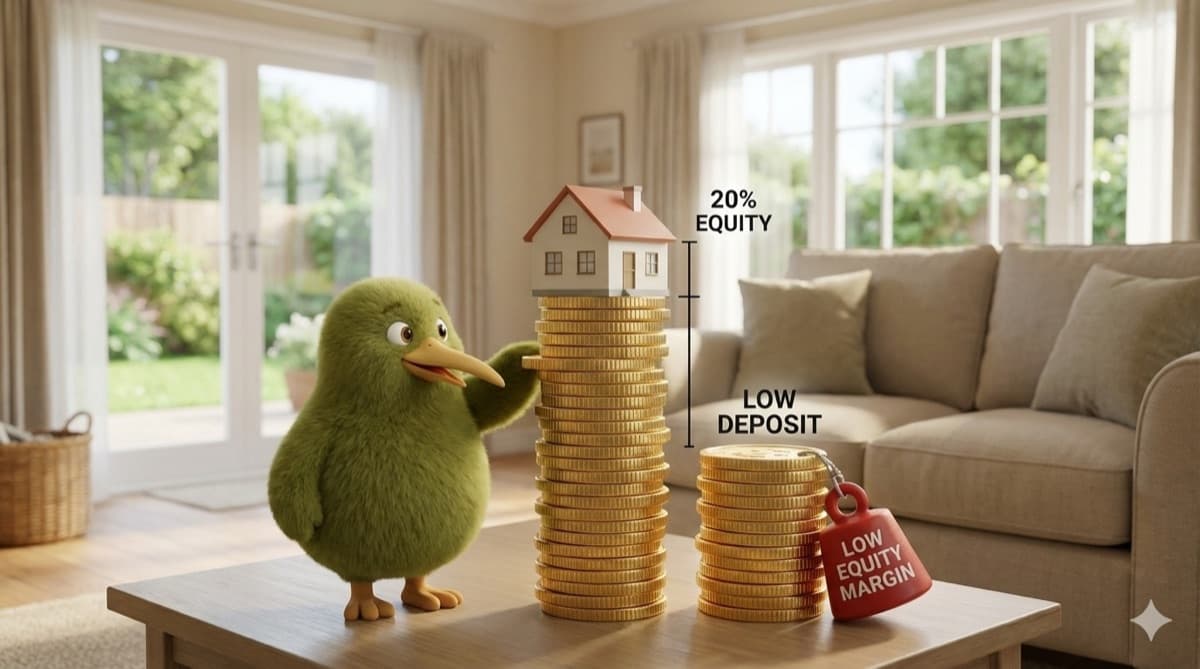
If you have less than a 20 percent deposit, many banks will apply a Low Equity Margin, often shortened to LEM. This is an additional percentage added to your interest rate to reflect the higher risk of lower equity lending.
This means two buyers purchasing similar properties could end up with different interest rates purely based on their deposit.
As your equity improves over time, a low-equity margin may be reviewed, reduced or removed depending on lender policy, valuation evidence and your loan position.
Helpful next step
Fixed vs Floating Rates: Where Structure Comes In
Another key factor influencing the rate you pay is how you structure your loan.
Floating rates tend to move more closely with the OCR and can change at any time. Fixed rates are locked in for a set period and are influenced more by wholesale markets and future expectations.
This creates an important difference between short-term and long-term fixed rates.
Why Short-Term and Long-Term Fixed Rates Are Different
When you look at fixed rates, you will usually see a range of options, from six months through to five years. The differences between them are not random. They reflect what the market expects interest rates to do in the future.
Banks set these rates based on where they think interest rates will be over the term you choose, not just where they are today.
If markets expect interest rates to fall over time, some shorter fixed terms may price below longer terms. Treat this as market pricing, not a reliable forecast for your own refix date.
In that situation, a longer fixed term may cost more because it gives more repayment certainty for longer.
If markets expect rates to rise, longer fixed terms can price in some of those expectations. Shorter terms may still look cheaper upfront, but they leave you exposed to whatever rates are available when you refix.
This is why comparing rates purely on what is cheapest today can be misleading.
Need personalised guidance?
Chat with a First Home Buyers Club affiliated mortgage adviser - no obligation!
Have a question about this?
Post it in the First Home Buyers Club forum — get answers from the community and industry professionals.
The Trade-Off Between Cost and Certainty
Choosing a fixed rate is not just about finding the lowest number. It is about comparing cost, certainty, fees, flexibility and refix risk.
Shorter-term rates can be cheaper upfront and give you flexibility, but they come with uncertainty when your loan needs to be refixed.
Longer-term rates may cost more, but they can provide repayment stability if rates increase more than expected.
Neither option is always better. The right fit depends on your financial position, risk tolerance, repayment buffer, break-fee risk and how much certainty you want in your repayments.
Global Influences: Why Overseas Matters
New Zealand does not operate in isolation. Global economic conditions play a major role in shaping our interest rates.
Changes in overseas interest rates, particularly in larger economies, can influence the cost for New Zealand lenders to borrow money. Global inflation trends and investor sentiment also feed into wholesale rates.
This means that even if everything locally appears stable, global changes can still impact mortgage rates here.
Expectations: The Invisible Force Behind Rate Changes
One of the most important influences on interest rates is market expectations.
Financial markets are constantly trying to predict what will happen next. These expectations are built into wholesale rates and, in turn, into the fixed rates offered by lenders.
This is why rates can move before any official announcements are made. The market is reacting to what it believes will happen in the future, not just what is happening today.
What This Means for First Home Buyers
When you put all of these factors together, it becomes clear that interest rates are influenced by a wide range of forces.
They are shaped by the OCR, driven by inflation, influenced by global markets, adjusted by bank costs and competition, and personalised based on your deposit and loan structure.
That may sound complex, but you do not need to understand every detail to make a good decision.
What matters is recognising that rates will change, and focusing on what you can control.
A Practical Way to Approach Interest Rates
Rather than trying to predict exactly where rates will go, it is usually more useful to think about your own situation.
Consider what you can afford with a buffer, how your repayments might change if rates increase, what fees or break costs could apply, and how much certainty you want.
Some borrowers discuss splitting their loan across different fixed terms with a lender or adviser. This can spread refix dates, but whether it suits you depends on your cash flow, goals, fees and appetite for uncertainty.
It can also create different refix dates, which may help with planning but can add complexity.
Why Understanding This Helps
Many first home buyers focus on finding the lowest rate available right now.
But the real advantage comes from understanding what that rate represents and how it could change over time.
When you understand what influences interest rates, you are better equipped to compare options and ask advice questions instead of reacting only to headlines or short-term movements.
The Reality: Rates Will Change, Your Plan Needs a Buffer
Interest rates will always move. They will rise, fall, and sometimes do the opposite of what people expect.
The key is not to get caught trying to perfectly time the market, but to have a repayment plan, buffer and review process you can live with.
If your repayments are manageable, your structure has been checked against your goals, and you understand the main rate drivers, you are better prepared for rate changes.
For first home buyers, that preparation can make rate changes feel more manageable, even though uncertainty never disappears completely.
Have a first-home-buyer question?
Browse related forum discussions
Public forum questions are searchable, with answer previews for visitors and full discussions for free members.
Frequently Asked Questions
Need personalised guidance?
Chat with a First Home Buyers Club affiliated mortgage adviser - no obligation!
Have a question about this?
Post it in the First Home Buyers Club forum — get answers from the community and industry professionals.
Related Articles

How To Get A Mortgage For Your First Home In New Zealand
Comprehensive guide to getting a mortgage for your first home in New Zealand. Learn about mortgage types, required documents, and how to assess your affordability.

How Much Can I Borrow For My First Home?
Comprehensive guide on mortgage borrowing capacity. Learn about income assessment, expenses, DTI ratios, and how to maximise your borrowing power.
Understanding Low Equity Margins in New Zealand
Essential guide on low equity margins (LEMs), low equity premiums (LEPs), and lenders mortgage insurance (LMI). Learn how to minimize these costs.

Mortgage Pre-Approval in New Zealand: What First Home Buyers Need to Know (2026)
Mortgage pre-approval is one of the most important steps when buying your first home. This guide explains how it works, what banks look for, and how to improve your chances of getting approved.